Melissa Farkouh
Visual aids for sounds and prosody - Downloadable
Visual aids for sounds and prosody - Downloadable
Couldn't load pickup availability
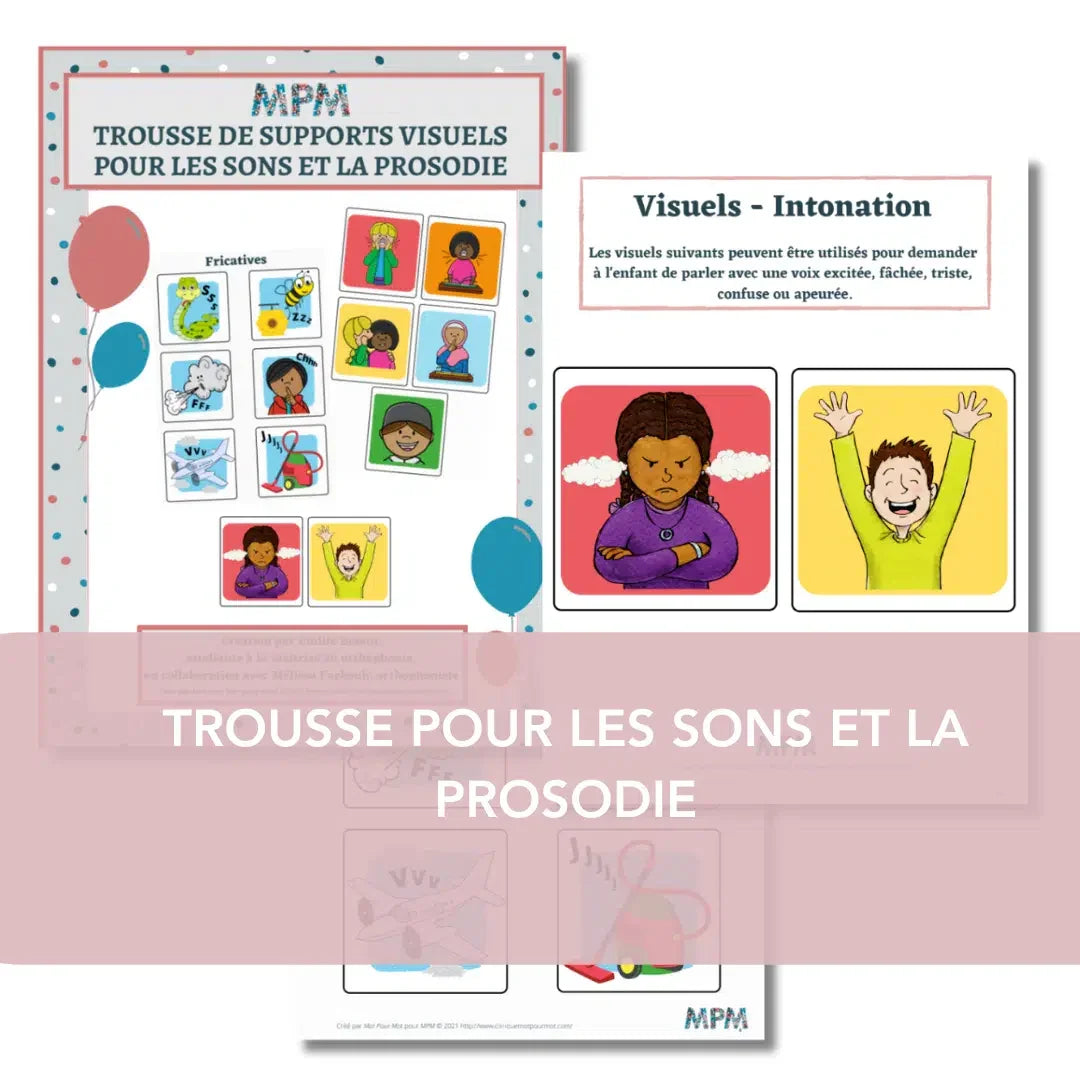
Our kit contains all the necessary materials to support the production of sounds and prosody in children with special speech sound needs.
Visual and Auditory Cue Cards: Sounds
You will find cards offering visual and auditory cues for the production of French sounds, created to provide an additional cue by linking the sound to noises in our environment. These cards serve as visual references that the child can refer to when having difficulty producing a sound.
For example, for the consonant "s", the visual cue of a snake is used because the snake produces the /s/ sound ("sssss"). This type of cue is one of many that a speech-language pathologist can provide to a child and must determine beforehand in their assessment.
The kit covers:
-
Consonants (17)
- Fricatives: /s, v, f, ʃ, z, ʒ/
- Plosives: /k, g, b, t, d, p/
- Liquids and nasals: /l, m, n, r, ɲ/
- Semivowels (3): /ɥ, w, j/
-
Vowels (15)
- Oral: /i, u, ə, o, ɛ, a, ɑ, y, ø, e, ɔ, œ/
- Nasal: /ɑ̃, ɔ̃, ɛ̃, œ̃/
Each card features an image representing the sound (visual cue) on the front and a brief description of the sound (auditory cue) on the back. These cards are designed for double-sided printing.
Visual Cue Cards: Prosody (15 cards)
The kit also includes cards for the following components:
- Speed: fast or slow pace
- Intonation: high or low pitch
- Volume: speaking loudly or not loudly enough
The chosen images help the child remember what is expected of them regarding their prosody. A description is provided on the back to facilitate use; you can modify the explanation for each as you wish.
Usage
These printable and laminable cards are suitable for various clienteles:
- Children with a developmental speech sound disorder (dyspraxia, phonology, dysarthria, orofacial myofunctional disorder)
- Very young children learning language who are beginning their sound development
⚠️ This tool should always be accompanied by the guidance of a speech-language pathologist and does not in any way replace speech-language intervention.
Share