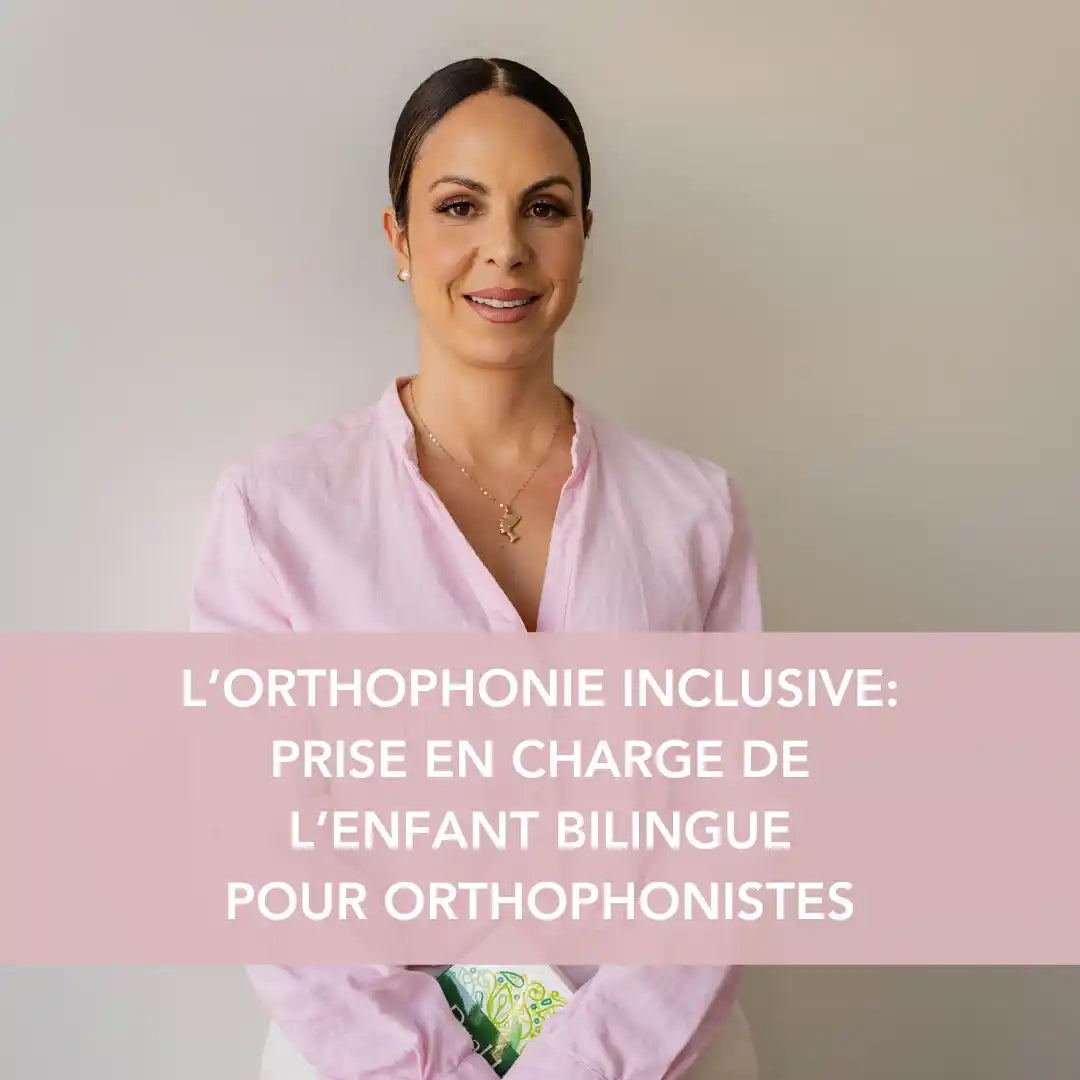
Melissa Farkouh
Inclusive speech therapy: Support for the bilingual child
Inclusive speech therapy: Support for the bilingual child
Couldn't load pickup availability
☀️ Summer Offer 2026: For any purchase of this training between June 1st and August 31st, 2026, a 2-hour live Q&A clinical meeting will be offered free of charge on October 14th, 2026, from 1:00 PM to 3:00 PM. A great opportunity to put things into practice, and to come back to discuss, exchange, or address any questions related to the management of multilingual children.
In this training, speech-language pathologists will be presented with evidence-based information for the comprehensive management of bilingual and multilingual children. Speech-language pathologists will also be introduced to the obstacles related to the assessment and intervention of children from linguistically and culturally diverse backgrounds.
Furthermore, speech-language pathologists will be prompted to reflect on the various factors influencing the linguistic development of bilingual children and to consider the cultural and linguistic biases of so-called "traditional" assessment, in order to assess appropriately with all the tools at their disposal.
Clinicians will be presented with clinical vignettes, numerous examples of cultural considerations, inclusive action plans, and assessment and intervention approaches in a bilingual context, in order to create a linguistic profile of the child, their learning potential, and to intervene effectively.
In short, this is a practical workshop that is pre-recorded into 3 large modules + a BONUS toolkit. It contains everything you need to confidently manage bilingual and multilingual children. You will have access to the content, all included tools, and notes for six months.
Online program objectives:
- Determine when a bilingual assessment is necessary or when it is better to wait
- Know what to do when a child is exposed to 3 languages;
- Have a better understanding of the available tests for conducting assessments;
- Provide appropriate intervention for bilingual children based on their reality so that the intervention is beneficial in all aspects of their life;
- Differentiate between a developmental language disorder and a child still acquiring their L2;
- Be better equipped to communicate with families from different backgrounds and school professionals who sometimes have preconceived notions;
- Enable speech-language pathologists to have avenues for reflection as well as concrete and inclusive actions to take when managing children from linguistically and culturally diverse backgrounds.
Pre-recorded workshop that you can listen to at your leisure for one year, divided into 3 large modules containing sub-modules of 5 to 15 minutes each, to which you will have access for six months + a BONUS TOOLKIT MODULE, for a total of 10.5 hours of training. The modules contain theory, evidence-based data, numerous examples from my clinical practice and those of past participants, self-reflections, clinical cases, questionnaires and answers, and as a BONUS, a detailed toolkit.
Module 1: Better understanding bilingualism and its challenges
- Obstacles related to bilingualism
- Definitions
- Factors influencing language acquisition
- Stages of language development
- The advantages of additive bilingualism
- Reflection activity
- True or False: Myths and facts about bilingual child development
Module 2: Inclusive management of bilingual and multilingual children
- Classic assessment
- Inclusive and alternative management:
- Reason for referral
- Ethnolinguistic interview and data collection
- Direct and indirect intervention + practical activity
- Dynamic assessment
- Information processing measures
- Language sample - discourse
- Speech sound assessment
- Using an interpreter:
- PL-96 in Quebec (optional)
- Analysis of language components
- Report writing
- 3 Clinical cases - reflection and analysis provided
Module 3 - Intervention
- Derogation? Schooling choice
- Intervention principles
- Coach and partner role with parents and professionals
- General language stimulation strategies
- Speech therapy approaches and treatment goals
- Concrete actions to cultivate a sense of belonging and openness to linguistic diversity
Module 4 - BONUS THE TOOLKIT
- Training
- Ethnolinguistic data collection tools
- Assessment and analysis tools
- Intervention tools and more
Share