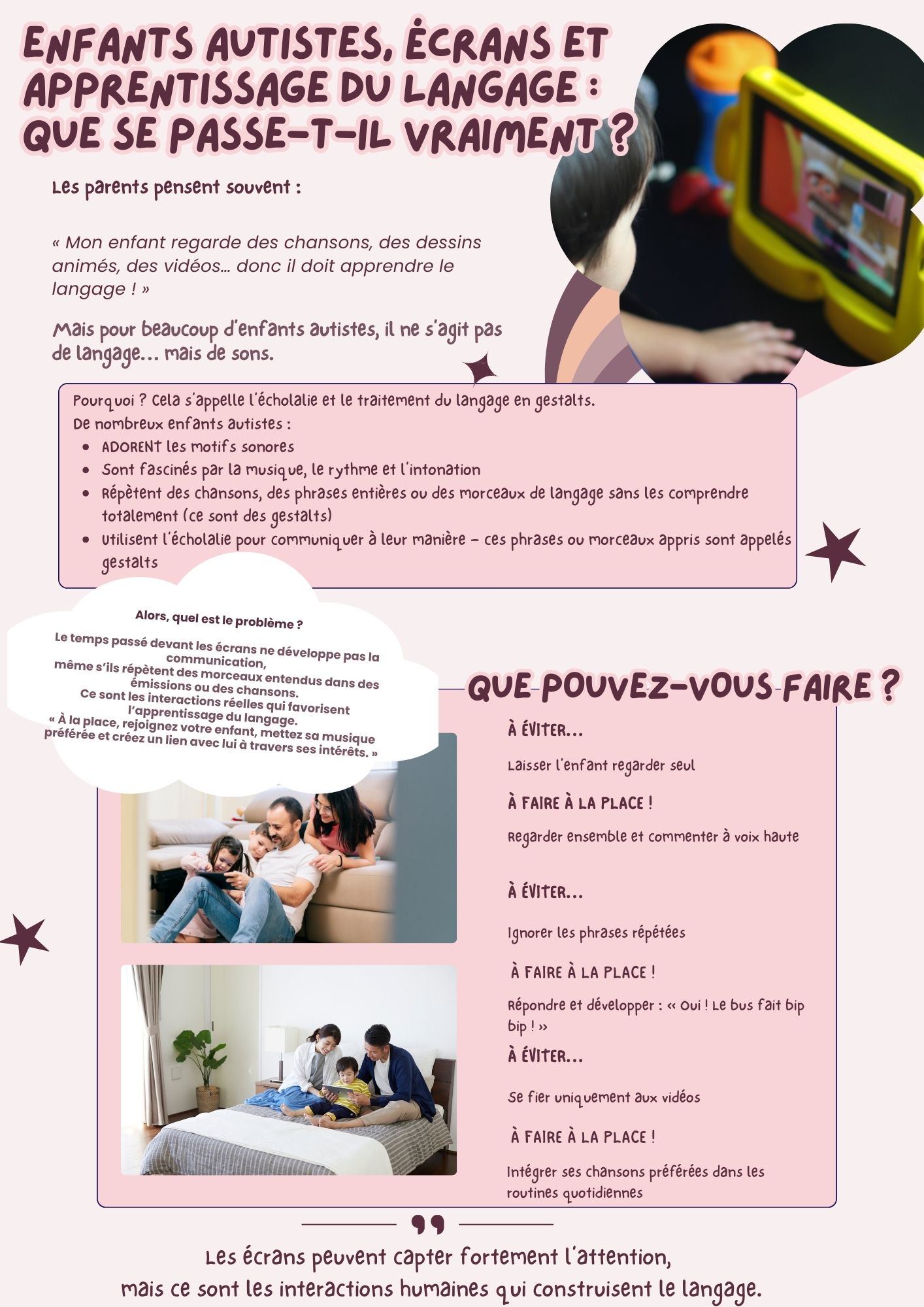
Understanding Gestalt language in autistic children: intonation, media, and learning
Some autistic children don't learn language word by word, but rather through "gestalt" processes, in other words, by chunks. This way of acquiring language, called gestaltic processing or natural language acquisition (NLA), is still too little known. Yet, a better understanding of it can transform your approach in speech therapy or language intervention.
What is Gestalt language processing?
Unlike the analytical model, where the child gradually learns isolated words and then constructs sentences, a large majority of autistic children learn by memorizing complete sentences or pieces of language heard in emotionally charged contexts: cartoons, songs, audio stories, by the adults around them…
These children are often called “intonation babies” because their attention is initially focused on prosody, rhythm, and melody. They repeat entire utterances, sometimes echolalic, before breaking them down for more spontaneous use.
The role of media in gestaltic learning
Audiovisual media play a central role for autistic children who are acquiring gestural language. Expressive dialogues, rhythmic lines, and the characters' marked intonations become a rich source of statements to integrate and reuse.
This is not a delay or an anomaly. It is a different, legitimate and valid developmental trajectory that deserves recognition and support.
Adapting our practices to support GLP children
- Adjust your expectations regarding linear language
- Recognizing the communicative value of echolalic scripts
- To provide an environment that facilitates the transition to a more flexible and personal language
With guidance and a caring approach, these children can become active communicators, in their own way.
Resources for further exploration
- Document for parents and professionals in French on the developmental processes of gestural and analytical language
- Let's Give Them Something to Gestalt About – The Informed SLP
- A Complete Guide to Gestalt Language Processing – Valued Voices
- Meaningful Speech: articles and training
- Adapting AAC tools for GLP
- Other resources: Sparking Speech, Autism Little Learners, Mary Barbera, Reddit GLP
In conclusion
Recognizing the diversity of ways in which people learn to speak also means valuing every voice. Gestalt therapy is not an exception to be corrected, but a variation to be supported. When you understand this approach, you pave the way for fairer, more humane interventions.